Best time for an outdoor wedding in Harbor Island, Bahamas
The reliable window runs 16 November to 11 May — when the floor of good outdoor time holds around 11 hours a day (no rain, no oppressive heat, no biting cold). The single most reliable two weeks are 25 January – 7 February, at a floor of 12 hours a day. Then it turns fast: by early June the floor has collapsed to about 3 hours, and it stays there — heat, humidity and the wet/hurricane season — until early October. These are floors (held in at least 24 of the last 25 years), not averages — and resolved to the week, not the month.
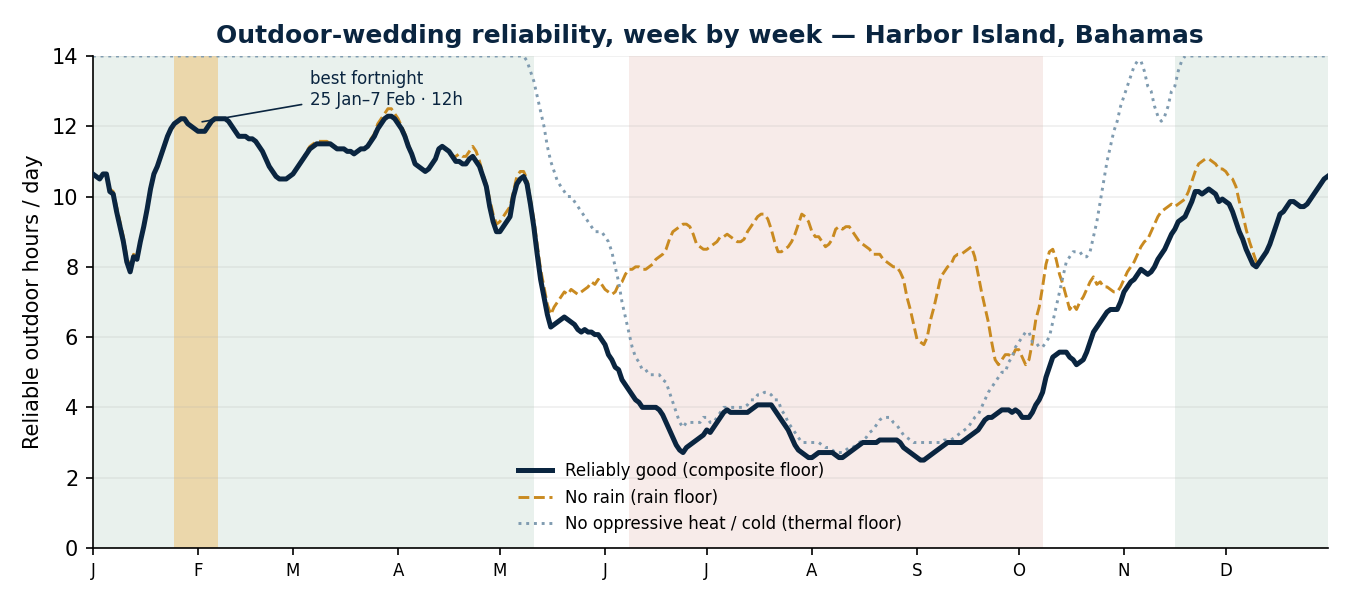
Reliable outdoor hours per day (8am–10pm), week by week. The green band is the reliable window; the red band is the stretch to avoid; the gold marker is the single best fortnight. Source: Forelore analysis of 25 years of NASA & Copernicus satellite record.
The reliability calendar
| Window | Dates | Reliable floor | What to know |
|---|---|---|---|
| Peak fortnight | 25 Jan – 7 Feb | ~12 h/day | The single most reliable two weeks of the year. |
| Reliable window | 16 Nov – 11 May | ~11 h/day | The season to plan an outdoor ceremony in. |
| Falling edge | 12 May – 7 Jun | 11 → 4 h | Turns over within weeks — book only with a solid backup. |
| Avoid | 8 Jun – 8 Oct | ~3 h/day | Oppressive heat & humidity, plus the wet/hurricane season. |
| Recovering edge | 9 Oct – 15 Nov | 4 → 9 h | Improving but still variable week to week. |
“Reliable floor” = good outdoor hours (8am–10pm) held in at least 24 of the last 25 years. Dates are the observed edges of each window, resolved to the week.
And within the day — which hours actually hold
A wedding happens at a time, not just a date. At Harbor Island the reliable hours shift across the day: the evening (6–10pm) is the most reliable time to be outdoors all year — reliably good about 53% of the block — while the afternoon (2–6pm), the heat of the day, is the weakest. The gap widens as the season turns: through the summer the evening is the only window that holds a floor at all (~34%), while midday and afternoon fall to zero. A sunset ceremony is the most reliable choice — and the last to fail.
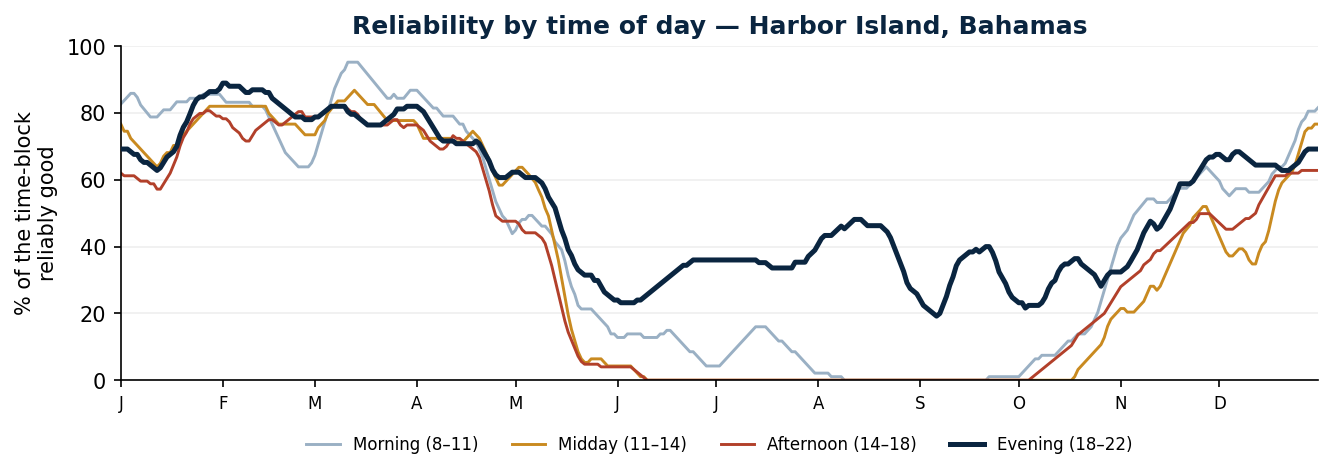
Share of each daytime block reliably good, week by week. Evening (6–10pm) leads year-round and holds longest into the off-season; the afternoon goes first. For a specific date, Forelore resolves this to the half-hour — the Inside-the-Day audit.
Why this is different
The edges fall inside the month
Every guide names “the best month.” But here the reliable window ends around 11 May — the first ten days of May are still excellent, the last ten already failing. A monthly “May is shoulder” average blurs exactly the edge you’re deciding on. We resolve it to the week — and, for a specific date, to the hour.
The level that actually holds
An average hides the year the heat or the rain showed up — the year an outdoor plan fails. Forelore reports the floor: the level of reliably-good outdoor time held in at least 24 of the last 25 years. It’s an audit of the observed record, not a forecast.
Have a specific date or venue in mind?
Get a free, date-specific reliability check — for Harbor Island or anywhere. We resolve your date to the hour and email you the read.
Check your date — free →Frequently asked
When is the best time for an outdoor wedding in Harbor Island?
The reliable window runs 16 November to 11 May, when the floor of good outdoor time holds near 11 hours a day. The single most reliable two weeks are 25 January – 7 February, at a floor of about 12 hours a day.
When should you avoid an outdoor wedding in Harbor Island?
8 June to 8 October. The reliable floor falls to about 3 hours a day — the binding constraint is oppressive heat and humidity, plus the wet and hurricane season.
Is this by month, or more precise?
To the week. The reliable window ends around 11 May, not “the end of May” — the edges fall inside the month, which is exactly where monthly averages mislead. For a specific date, we resolve it further, to the hour of day (a 5pm ceremony and a midday lunch are different questions).
What time of day is best for an outdoor wedding in Harbor Island?
The evening (6–10pm) — it is the most reliable block year-round, reliably good about 53% of the time, versus about 35% for the afternoon (2–6pm, the heat of the day). Through the summer the evening is the only window that holds a floor at all. A sunset ceremony is the most reliable choice.
How is this measured?
From 25 years of NASA GPM IMERG (rain) and Copernicus ERA5-HEAT UTCI (thermal) satellite record. The figure is a conservative floor — the level held in at least 24 of the last 25 years — not a typical-year average, and not a forecast.